
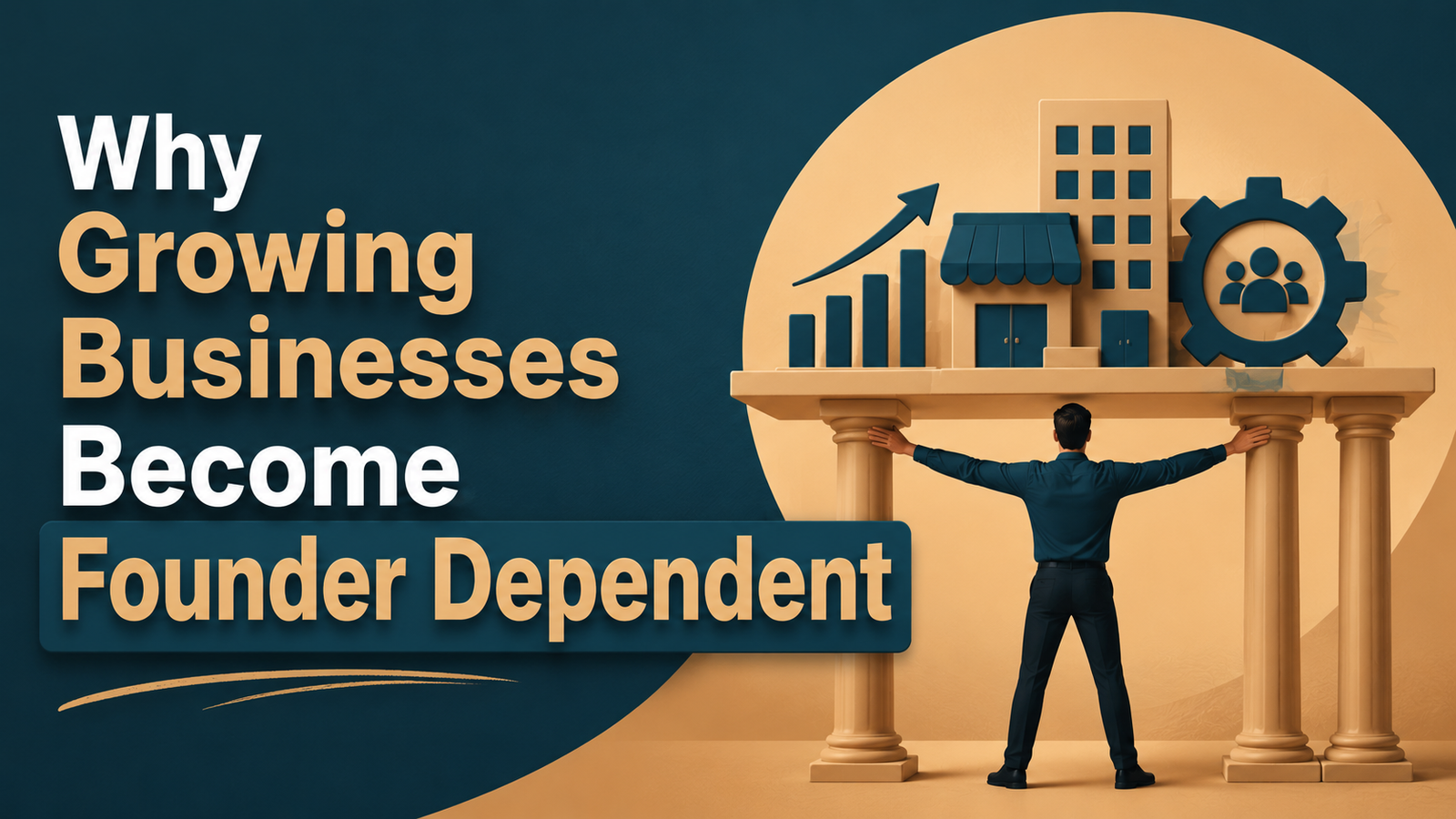
Most founder-led businesses do not fail because the market is weak.
They struggle because the business slowly becomes dependent on one person.
The founder becomes the approval system. The communication system. The escalation point. The project manager. The quality controller.
At first, this feels normal.
In the early stages, founder involvement creates speed. Decisions move quickly. Teams stay aligned. Problems get solved immediately.
But as the company grows, the same involvement starts creating operational bottlenecks.
Execution slows. Teams hesitate. Managers stop taking ownership. Customers wait longer. Founders become overwhelmed.
And eventually, growth starts increasing stress instead of freedom.
What Founder Dependency Actually Looks Like
Founder dependency is rarely obvious in the beginning. Most businesses only notice it when growth becomes harder to manage.
You will usually see patterns like:
- Managers constantly waiting for approvals
- Teams depending on reminders to complete work
- Employees escalating small decisions
- Daily execution slowing during founder absence
- Customers waiting for founder responses
- Delegation creating more confusion instead of leverage
- Execution quality changing from person to person
- Teams relying on memory instead of systems
Many founders assume these problems happen because their team lacks capability. But in most cases, the real issue is operational structure. The business was built around founder involvement instead of scalable systems.
Why Growing Companies Become Founder Dependent
Most founder-led businesses unintentionally create operational dependency while scaling. This usually happens because growth comes faster than operational maturity.
The founder hires quickly. New managers join. More clients arrive. More communication channels open. But the systems behind execution never evolve.
Instead of building clear workflows, accountability structures, SOPs, and reporting systems, the business continues operating through:
- WhatsApp messages
- Verbal instructions
- Follow-ups
- Founder memory
- Constant supervision
This creates invisible operational debt. The company appears busy from the outside. Internally, execution becomes fragile.
The moment the founder steps away, the gaps become visible. Tasks pause. Decisions slow. Teams become reactive. Ownership disappears.
This is why many businesses feel stuck between 10 and 100 employees. The complexity grows faster than the systems.
The Hidden Cost of Founder Dependency
Founder dependency does not only create stress. It quietly damages execution across the entire business.
1. Decision-Making Slows Down
When every important decision goes through the founder, approvals become bottlenecks. Managers stop making independent judgments because they are conditioned to seek validation. Over time, teams lose confidence. Execution slows due to uncertainty.
2. Teams Avoid Ownership
People avoid responsibility when ownership is unclear. If the founder always intervenes, employees learn that accountability ultimately belongs to leadership. This creates a culture of escalation instead of ownership.
3. Operations Become Reactive
Without structured workflows, teams depend on reminders, meetings, and follow-ups. Managers spend hours checking task status instead of improving systems. The company stays operationally busy but strategically slow.
4. Customer Experience Becomes Inconsistent
Different employees execute work differently. Knowledge stays inside people's heads instead of documented systems. As the team grows, quality variation increases. Customers experience delays, confusion, and inconsistent delivery.
5. Founders Become Operationally Trapped
Many founders dream about scaling to create freedom. But founder dependency creates the opposite. Growth increases interruptions. The founder becomes the central operating system of the company. And eventually, leadership time disappears into operational firefighting.
The Real Root Cause Behind Founder Dependency
Most businesses treat founder dependency as a people problem. It is usually not. The deeper issue is the absence of operational clarity.
Teams cannot execute independently when:
- Ownership is unclear
- Decision authority is undefined
- SOPs do not exist
- Workflows are undocumented
- Reporting systems are weak
- Priorities constantly change
- Accountability is verbal instead of visible
People cannot scale chaos. Even highly capable employees struggle inside unclear operational environments. When execution depends on memory, follow-ups, and founder involvement, dependency becomes inevitable.
This is why hiring more people rarely solves the problem. Without systems, complexity only multiplies operational confusion.
Why Delegation Often Fails in Growing Businesses
Many founders believe delegation means assigning tasks. Real delegation requires operational infrastructure.
Without systems, delegation creates more problems instead of leverage. Employees misunderstand expectations. Tasks require repeated corrections. Managers fail to track outcomes. Communication gaps slow execution.
Eventually, founders start micromanaging again because it feels faster. But micromanagement is usually a symptom of unclear systems.
Strong delegation only becomes possible when businesses create:
- Clear responsibilities
- Documented workflows
- Defined success metrics
- Decision-making boundaries
- Standardized execution processes
- Reporting visibility
Good systems reduce dependency on constant supervision. That is what creates scalable execution.
How System-Driven Companies Operate Differently
System-driven companies do not scale because people work harder. They scale because execution becomes structured. Operational clarity replaces operational dependency.
In system-driven businesses:
- Teams know who owns outcomes
- Managers make decisions confidently
- Workflows are documented
- Reporting systems create visibility
- Accountability becomes measurable
- Execution stays consistent across teams
- Problems get identified early
- Founders focus on strategic decisions instead of daily coordination
This does not remove human leadership. It removes operational chaos. The goal is not to eliminate founder involvement completely — the goal is to prevent the business from collapsing without constant founder intervention.
The Operational Systems Every Growing Business Needs
Most founder-led companies do not need more motivation. They need better operational infrastructure. Here are the foundational systems growing businesses should prioritize:
1. SOP Systems
Document recurring processes. If execution depends on memory, the business becomes fragile. Good SOPs improve consistency, onboarding, delegation, and accountability.
2. Ownership Structures
Every important outcome should have a clearly assigned owner. Ambiguous responsibility creates delays and escalation.
3. Workflow Systems
Teams need structured execution paths. Without workflows, coordination gaps increase as the company grows.
4. Reporting Systems
Leadership should not depend on verbal updates. Strong reporting creates visibility across operations.
5. Decision-Making Frameworks
Teams should know what decisions they can make, what requires escalation, what metrics define success, and what priorities matter most. Clear boundaries reduce approval bottlenecks.
6. Accountability Systems
Accountability should be operationally visible — not dependent on reminders. The best businesses build systems where progress, ownership, delays, and blockers become transparent.
Signs Your Business Needs Operational Systems
Many founders normalize operational chaos because the business is still growing. Revenue can hide structural problems for a long time. But certain signals usually indicate deeper operational dependency:
- Teams constantly ask for clarification
- Managers avoid independent decisions
- Founder absence slows execution
- Meetings increase but clarity does not
- Teams stay busy without meaningful progress
- Deadlines shift repeatedly
- Work quality varies across employees
- Follow-ups consume leadership time
- Communication feels fragmented
- Execution becomes reactive instead of proactive
If these patterns exist consistently, the issue is probably systemic. Growth without systems creates operational fragility.
How to Reduce Founder Dependency Without Slowing Growth
The solution is not removing the founder overnight. The solution is gradually transferring operational clarity into systems.
Start with:
- Documenting recurring processes
- Defining ownership clearly
- Building reporting structures
- Creating standardized workflows
- Establishing decision boundaries
- Improving cross-functional visibility
- Reducing verbal dependency
Do not try fixing everything at once. Operational transformation works best incrementally.
Final Thought
Founder dependency is one of the most common scaling problems in growing businesses. But it is also one of the most misunderstood.
Most companies think they need better employees, more meetings, stronger management pressure, more follow-ups. In reality, they usually need operational clarity.
Businesses become scalable when execution moves from people-dependent to system-driven. That shift changes everything. Teams move faster. Ownership improves. Execution becomes consistent. Founders regain strategic focus. Growth becomes sustainable.
Operational chaos is rarely a motivation problem. It is usually a systems problem.
Clifti helps founder-led businesses become system-driven companies through operational clarity, workflows, accountability systems, and scalable execution structures.
Ready to stop being the bottleneck?
We're onboarding a few clients where we work with them for free. When it's full, applications close.
Apply to Work With Us →